Tuesday, August 28, 2012

Andrew Peterson - Light for the Lost Boy


Andrew Peterson’s boldest, most imaginative work

Light for the Lost Boy
Artist: Andrew Peterson
Label: Centricity
Length: 10 tracks/48:57 minutes

Light for the Lost Boy by Andrew Peterson is his boldest, most imaginative work. The theme and music are more fully realized than any of his previous releases, with the possible exception of Behold the Lamb of God: the True Tale of the Coming of the Christ, a Christmas classic.

Aside from the winsome songwriting, a major reason is the production team of Jason Cooley, Ben Shive and Andy Gullahorn, all long-time collaborators, who take Peterson’s music to a new level. It’s not radically different; they just make the production a little more sophisticated and include some programming and other embellishments.

“The Cornerstone” is the most obvious example. Vocal layering, a snatch of ethereal keyboard reminiscent of Jeff Johnson, a haunted swirl of B3 and unhinged guitar imagine a God strange and wild. It’s Peterson as you have rarely heard him. It’s a child’s view: a God inscrutable.

The latter is what also makes this noteworthy. Much of Lost Boy is a perspective on childhood and the loss of innocence. It is fertile ground for exploring mystery and wonder along with questioning and doubt. The hard-edged notes underscore that the world is fallen. All is not as it should be.

Peterson directly addresses his children on “You’ll Find Your Way.” Most songs are more subtle, lighting a path for them to follow. This is record that they can return to when older, encouraging them to order their ways aright.

Songs like “Carry the Fire” bring the welcome reminder that we are not alone. God gives marvelous comrades that support us when we falter.

This steadfast, unconditional love is highlighted on “Rest Easy,” which Peterson wrote with his wife in mind, but also represents Christ’s love for his church. A wondrous thing happened when they began conceiving a video for what is perhaps the finest single that Peterson has ever done. Why not have a contest and let fans interpret the song? Check out the first place winner with tissue in hand. This is a near perfect piece of pop with a bittersweet video.

The epic, “Don’t You Want to Thank Someone,” clocking in at nearly 10 minutes, offers this resolve to the recurring storyline: “Every little boy grows up, and he’s haunted by the heart that died/Longing for the world that was before the Fall/Oh, but then forgiveness comes/It’s a grace that I cannot resist/Oh, I just want to thank someone/I just want to thank someone for this.”

One can surmise that Peterson’s work as an author of children’s books has influenced this work, including the enchanting cover. Since this may be his best release yet, let’s hope that in addition to writing whimsical adventures, he keeps singing them. I will keep listening as long as he does.

Wednesday, August 15, 2012

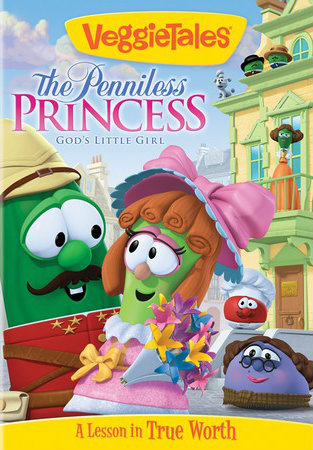
VeggieTales: The Penniless Princess—God’s Little Girl, DVD


Remake of a classic is brilliant, as the British might say.

VeggieTales: The Penniless Princess—God’s Little Girl, DVD
Publisher: Big Idea Entertainment (www.veggietales.com)
Running Time: Approximately 50 minutes

Larry the Cucumber dons British attire and accent to introduce The Penniless Princess, an adaptation of the classic children’s book, A Little Princess, by Frances Hodgson Burnett. The stage is set for this London story by a question: How do you love those who are less than kind? The answer comes with knowing the true source of our worth. Hint: it’s not derived from material things. It has to do with who we are in God’s sight.

This has it all: a compelling story, biblical values, gorgeous animation, excellent music, simple but witty dialog, and moving moments balanced by the zany humor that is uniquely VeggieTales. Speaking of the latter, upon arriving in London, Papa Razzi with his filmless camera, remarks to his companion, who wants to see a musical, “Musicals are so unrealistic, people bursting into song for no reason.” Immediately, a porter appears singing, “Might I fetch your bag?” Suddenly, he is singing in reply.

This is a musical of sorts, but it is not overdone, for those who might not fancy “people bursting into song for no reason.” It is similar to previous DVDs. A new silly song, “Best Friends Forever,” a humorous take on all kinds of texting acronyms, serves as an intermission in the middle.

In the story, Miss Minchin, who is as mean as Sara Crew is kind, indirectly provides some of the comedy. On almost every occasion when the former’s name is mentioned, there is an ominous neighing of horses. She also happens to be allergic to Mortimer, Sara’s teddy bear, which leaves her in a disheveled state that is most unbecoming. It serves as just punishment for her cruelty.

Unwittingly, Miss Minchin (horses neighing), brings out the best in Sara, who goes from a life of privilege to having nothing. Here a parallel is draw between her and Joseph, the Old Testament patriarch. Joseph went from wearing a princely robe and dreams that exalted him above his family to an extended stay in an Egyptian dungeon. It’s not the change of circumstance that he or Sara would choose, but we learn that with God, one is a prince or princess in any situation, no matter how difficult.

Before having his life cut short by cancer, my dad was greatly comforted by Max Lucado’s writings. One day he insisted that my mom write down the words he read in A Love Worth Giving: “God loves you simply because He has chosen to do so. He loves you when you don’t feel lovely. He loves you when no one else loves you. Others may abandon you, divorce you, and ignore you. But God will love you. Always. No matter what.” As I watched The Penniless Princess, I could not help recalling these words, which are continually repeated almost verbatim in this marvelous story.

Since we are all made in God’s image, we all have worth. It’s what inspires Sara’s kindness to everyone. We can love because God loves us and each person is his unique creation.

Should we ever doubt God’s love, the closing lesson from Romans 8:39 provides assurance that nothing “will be able to separate us from the love of God ….”
    
VeggieTales has created a classic of their own from this engaging children’s story. To borrow a phrase from the British, this is brilliant.

It might even lead people to the book. Books tend to excel the movies they inspire. Even so, let’s hope that this won’t be the last to inspire a new VeggieTale. 

Friday, June 1, 2012

Now - Fireflight


On the way to the Celestial City, Fireflight stoop to lift people out of the swamp of despair.

Now
Artist: Fireflight (www.fireflightrock.com)
Label: Essential
Length: 10 tracks/36:11 minutes

Imagine someone in the depths of despair. They have no hope. They live in the shadows of this world. Their existence is tortured and self-destructive. They identify with heavy music that expresses the weight they feel.

Along comes Now the fourth release from the female-fronted Fireflight, a voice for the desperate. This has the characteristic heavy chords but none of the sense of doom that other artists in the genre might project. These songs are like light that streams into dark places.

God is that light, though he is rarely explicitly referenced here. The band avoids being preachy. The only direct mention is on “He Weeps,” one of two ballads, the other being “Rise Above.” That these are my two favorites shows my bias for quieter melodies.

The rest are sometimes heavy, fast and intense. It is sweetened by programming in the quieter moments, often at the beginning and end of a song. The production is tight and excellent throughout.

Getting back to “He Weeps”; it is the answer to that age-old question, “Where is God when …” You fill in the blank. God weeps when we “taste defeat.” He is there in our darkest moments. Fireflight cheers on listeners, especially the broken, with this message.

These songs are loaded with encouragement and hope. To borrow from the imagery in Pilgrim’s Progress, Fireflight is on the path that leads to the Celestial City. On their way they purposely stoop to lift people out of the swamp of despair. Their music and words speak the language of the despondent. The time to rise above is now.

“Stronger Than You Think,” which directly addresses the work of Satan, exhibits a disdain for the dark side and a confidence that those who belong to God can know.

It was the passion that I saw and heard in a Fireflight video that drew me to this release. As much as I like mellower music, I recognize that rock, and in particular the heavier form of it, can be the best vehicle to convey the desperation and turmoil in this life. Anyone who has ever seen U2’s “Pride” video can also see rock’s ability to communicate passion. There is a fire in this band to take the light to dark places.  

Forever Reign - One Sonic Society


One Sonic Society recognizes that it is better to worship a transcendent God than to foster the illusion of being a super-group.

Forever Reign
Artist: One Sonic Society (www.onesonicsociety.com)
Label: Essential Worship
Length: 10 tracks/56:50 minutes

I want to call One Sonic Society a modern worship super-group, but no band in their right mind will want to wear such a label. When Eric Clapton, Steve Winwood, Ginger Baker and Ric Grech formed Blind Faith, shortly after the dissolution of the super-group Cream, this new incarnation was being promoted as such, but the expectations that came with it were a burden. So even though the three members of One Sonic Society are all highly-skilled, I won’t weigh them down by attaching an unrealistic title.

Nonetheless, you should know a little of their background. Jason Ingram is a name that you will often see as a writer, producer and performer on worship music releases. Of course, Delirious is an instantly recognizable name to many. Since their disbanding, guitarist Stu G has been involved in session work, which may have led in part to this collaboration. Paul Mabury, a native of Australia and one of Nashville’s most in-demand drummers, rounds out the group.

Even with such exceptional parts, the sum is greater than the individual talents. It is a sonic joy to hear the rich blend of vocals and music. Alice Cooper has rightly stated that part of what made musicians like George Harrison, Jeff Beck, Keith Richards and Ringo Starr great was what they didn’t play. They play at the right time. Similarly, there is no excess here. What makes me appreciate Stu G more than ever is not his abandon, but the near perfect restraint that hears him playing just the right thing. The same could be said of the others on this recording.

They do not reinvent the genre. They make it their own by using just enough creativity to make it interesting while keeping it engaging. There is a definite Euro influence, which occasional has a more industrial edge. That and the sometimes ethereal base come from the use of programming. It all makes for a solid collection that I took to immediately and can easily listen to repeatedly.

The songs often start quietly before becoming anthems. My spirit soars with group background vocals that give this a live feel, while having the superior fidelity of a studio release. It is the best of both worlds.

I am not sure how many of the songs count as new ones, but I suspect that most fall in that category. The writers, in addition to group members, are some of the best in the business. The only track familiar to me, “Forever Reign,” was co-written by Ingram. Though there have probably been numerous versions, here the keyboard notes dance like rain bouncing off a roof. Stu G’s guitar drives the chorus. It’s one highlight among many.

Modern worship has been criticized and perhaps rightly for some of the ways it has fallen short. However, those who may be cynical should remember that it is often inspired by a sincere desire to facilitate an experience of God’s presence. I listened to this one Saturday near the beginning of my day and it changed my outlook. Those like my sister, who relish this type of music, know that just listening can draw one heavenward. I realize how valuable a recording like this can be, especially for those who may be prone to depression or feelings of hopelessness.

These highly skilled servants of Christ more than meet expectations but demonstrate their humility by harnessing their talents in a way that brings glory to Christ. It’s like they are throwing their crowns before God’s throne. They wisely recognize that it is better to worship a transcendent God than to foster the illusion of being a super-group.

Reformation Commentary on Scripture: Old Testament XII Ezekiel, Daniel


A starry sky of reformation lights illuminates the meaning of some of the most challenging material in the Bible.

Reformation Commentary on Scripture
Old Testament XII
Ezekiel, Daniel
Editors: Beckwith, Carl L; George, Timothy (General Editor);
Manetsch, Scott M. (Associate General Editor)
Publisher: IVP Academic (www.ivpress.com)
Pages: 452

My reason for requesting Ezekiel, Daniel was the opportunity to read commentary from reformers like Martin Luther, John Calvin, John Owen, John Bunyan, Richard Baxter and many other ancient expositors. This volume provides the opportunity to see how they interpreted these challenging Old Testament books. What I read convinces me that the existing and forthcoming volumes in this series will be a valuable addition to any theological library. Collect them all if you value commentaries.

These commentators stand outside our era and culture offering varied and different interpretations than their modern counterparts. They may not always be right, and they don’t always agree, but echoing the thought of G. K. Chesterton, they should have a voice at the table. It is not just contemporaries that need to be heard.

One instance where the reformers agree, but may be wrong, is their reading of the description of the temple in Ezekiel 40-48. They see it as figurative of the Church and heaven but not literal. This stands in sharp contrast to the many today looking for a literal rebuilding of the temple.

When Christ took hold of my life in the late 1970s, it wasn’t long before I encountered teaching on Ezekiel 36-38. Many see a reference to Russia invading Israel in the last days. While that may be the case, the reformers do not have the same emphasis. I value their perspective because it can keep us from having a narrow view. The second part of Proverbs 11:14 states that “in an abundance of counselors there is safety.” A consensus of opinion is worth considering and may help one to avoid error.

This volume effectively brings together the reformers’ most concise thoughts, which are drawn from a multitude of writings. Though this is a strength, it is also a slight shortcoming. Instead of getting detailed exposition on every single verse, you get commentary on select verses and overviews of passages, which may leave a reader wanting to know more and reaching for other resources. This might work best alongside a modern commentary using it in a way that one might compare old and modern translations of the Bible.

One feature I appreciate is the editor’s summary of the reformers’ thoughts on a passage, which follows the text of Scripture. Immediately readers have a general sense of the reformers’ understanding. This is a valuable feature.

The reformers comments come next, grouped under the appropriate text reference. This is further broken down by content specific headings for each commentator, whose writings normally stretch from one to three paragraphs. This layout is excellent, making it easy to navigate. The entire text of Ezekiel and Daniel is given in the English Standard Version except where noted.

This changed the way I see Ezekiel’s visions. I saw Christ more clearly than I ever have before. The reformers’ reverence and godliness shines through the material.

Overall, the exposition is sound, though it occasionally has a Calvinist and anti-Papist slant. The latter is no surprise; these our protestant reformers! But like the Calvinist leanings, this material is just in passing. The editor limits the discussion to what is pertinent.

Reading the many passages by Calvin, one quickly realizes that he is a fine expositor. I enjoyed his thoughts, even though I might disagree with some Calvinist doctrine.

These expositors do an admirable job on some of the most challenging material in the Bible. Where else can you find such a starry sky of reformation lights illuminating the revelations in these two books?

Finally, the color scheme and artwork in this series is my favorite among the Ancient Christian sets of books. The main color is a pleasing shade of green with off-white lettering. “The Paradise,” the Protestant Church in Lyon is part of the jacket artwork.

Love is Making a Way - Sixteen Cities


Love is Making a Way expresses the simplicity and childlike charm of the love found in God.

Love is Making a Way
Artist: Sixteen Cities (www.sixteencities.com)
Label: Centricity Music
Length: 10 tracks/34:58 minutes

Some music is dark, depressing and even cynical. It can be filled with anger and angst, and to a degree that may be an appropriate expression at times. However, a steady consumption without resolve is probably not a healthy choice for most people.

One thing I appreciate about Love is Making a Way by Sixteen Cities is the hopeful outlook. Love is an obvious theme. To dwell in God is to know love. Living in love gives rise to hope. Thus you have the inspiration for many of these songs.

The title song, which is the first single, starts with acoustic strumming, a chorus of “oh’s” and a slightly off-kilter drum rhythm. Lead vocalist, Josiah Warneking, begins to sing over the background of a soaring synth that has a life of its own. Right there they have me even before the catchy, winsome chorus.

The love they sing of is illustrated on the cover by a heart-shaped collage showing jumbled maps of different states. It is highly appropriate given that love can be difficult. It can be hard to find and easy to lose your way. Though there are many twists and turns, Love is Making a Way points us to the simplicity and childlike charm of the love found in God.

It expresses itself in worship as on “Glorious” and has a swift rock-edge on “All Around the World.” “Mercy (Fall on Me)” takes an introspective turn recalling the promise that God’s mercies are new every morning.

The last three songs, “Walk on Water,” “I Need You” and “Consume Me,” are my favorite stretch. These are more acoustic and contain some of the strongest melodies. They are pleasantly engaging.

On the downside, I found myself longing for more artistry, particularly in the use of words and phrases. It reminds me of when I first heard Rich Mullins. Not everyone can write like he did, but I remember the joy of discovering a Christian artist that wrote like a poet.

Lead singer Warneking has a great voice and has at least a co-write on every song. He gets help from several others including Jason Ingram on “Consume Me,” which may be the best song of all.

There are several producers that work on different tracks. The music is tight and the production is clean. 

This is a solid release for Sixteen Cities. In a world characterized by darkness, it’s encouraging to hear these godly affirmations and desires. 

Mark: The Beginning of the Gospel (CD) - Michael Card


Card’s insightful commentary inspires these songs.

Mark: The Beginning of the Gospel
Artist: Michael Card
Label: Covenant Artists
Distributor: InterVarsity Press (www.ivpress.com)
Length: 10 tracks/33:56 minutes

Being a companion to his commentary, Mark: The Gospel of Passion, Michael Card’s Mark: The Beginning of the Gospel provides 10 new opportunities to imagine the fast-moving drama in the Gospel of Mark. Looking more like a professor than a musician on the back insert, Card takes the opportunity to combine his scholarly talents with those of a seasoned recording artist to highlight distinctives found in Mark.  

This is the first gospel to be written, one that “uniquely portrays the emotional life of Jesus in simple, urgent language.” This theme is the setting for the spirited a cappella opening, “The Beginning of the Gospel,” sung by the Fisk University Singers.

Though a solo artist, the concept of community is increasingly important to Card. You see it in his frequent collaborations with other artists and in the way he invites others to participate in Bible study. Knowing this, I look forward to contributions from friends and colleagues on each new recording. Getting back to the opening song, though written by Card, it is arranged, performed and conducted by the aforementioned choir and their associates. It is a measure of Card’s security that he can step back and give prominence to others on his own recording.

You find it once again on the closing track, “Is It All Over Now,” where Christine Dente, formerly part of Out of the Grey (with her husband Scott), sings all of the lyrics written by Card and veteran producer Brown Bannister. This is an excellent choice since here the story of Christ’s resurrection is told from the point of view of one of the women at Christ’s tomb. Card’s involvement with others demonstrates that music (and life) can be richer when we invite people to share their talents.

Scott Dente and Ken Lewis do all the producing, bringing a slightly fuller, richer sound than on Card’s last outing, Luke: A World Turned Upside Down (2011). This duo has provided excellent musicianship and production to the most recent recordings by Twila Paris and Tanya Godsey. Fans of Out of the Grey might not miss that group as much when they recognize how well they support artists like Card.

You might not think that stringing together the words “A Great Wind, A Great Calm, A Great Fear” would work as a chorus, but the luscious harmonizing does the trick. One of the most beautiful moments is the seamless transition from the opening track to the first acoustic sounds heard here that play like the breeze on a wind chime.

And what would a new Michael Card recording be without a banjo song? It has becoming one of his most endearing sounds. “The Service of the Sod” is his latest bluegrass-flavored foray. It starts with an excerpt from what sounds like an old sermon, which is the source of the title. The seed is sown, and how it grows is a mystery. The background is the unique parable from Mark.

Card, and co-writer Sarah Hart, show the depth of Christ’s identification with us on “You Walk in Lonely Places”:

Lord you walked in lonely places
Oh you felt our emptiness
Lord you walked in lonely places
To know the pain of man

The haunting music perfectly conveys the sober mood. Despite the tone, the closing refrain is like a lifeline of hope:

And in my darkest hours
I can call upon Your name, oh Lord
And You come into the solitude
Of what I cannot face alone

“In Memory of Her Love” commemorates an exquisite act of unrealized service. Astonishingly, Jesus said of the woman who unwittingly anointed him for burial, “Truly, I say to you, wherever the gospel is proclaimed in the whole world, what she has done will be told in memory of her” (Mark 14:9 ESV). The song is as beautiful as the act that inspired it.

You won’t find a hit song here, or a potential classic along the lines of Card’s early work (“El Shaddai” & “Immanuel”), but I like this better. It is a mature offering with finely textured music and depth of feeling and insight. Who else but the cerebral Card would title a song “The Paradigm”?

Sadly, this will not get the same attention as the trendy music on Christian radio, but it deserves to be heard just as much if not more because it is so substantive. This is on par with Card’s best work. It’s a superb companion to his commentary, which is not only a lot of fun; it is filled with great insights, just like this recording. As I listened, I could not help thinking about Card’s commentary, which informs these songs. 

The Ache - Brandon Heath

  An honest look at life and one of the best recordings of the past year. The Ache Brandon Heath Length: 11 songs/36 minutes Label: Centri...