Saturday, March 30, 2013

The Becoming - Jenny Simmons


Former Addison Road singer lets questions lead to a more satisfying faith

The Becoming
Artist: Jenny Simmons (www.jennysimmons.com)
Label: Fair Trade Services
Length: 10 tracks/37:45 minutes

Part of The Becoming by Jenny Simmons is gaining the right perspective. On “Where I Belong,” the peppy opener, Simmons sings, “I, I am right where I belong/Don’t need a place to call my own,/With You I am home.” What if, despite waywardness, restlessness and strife, we are right where we belong? Is there consolation in knowing that even when Christ’s followers lose their way, they can rest in belonging to Him?

Questions multiply on the next song, “What Faith is About”:

What if I'm not sure I heard You right
And I've found a thousand reasons not to try?
And what if I can't face the great unknown
But there's no way back and nowhere left to go?

Here, the searching ultimately leads to a more satisfying faith:

But what if I try even when I'm scared
And Your courage meets me there?
What if I hope against all hope
And believe in every trial

Experience becomes the hope found in “This I Know,” “When I take my final breath/I know I’m ready/Heaven waits for me.” It’s the confidence that having lived well by grace, no matter how one departs this life, one can look forward to being with Christ.

These first three songs are radio-friendly, in the pop/rock mode, but the fourth, a personal favorite, has a reggae rhythm punctuated by slide guitar. It’s whimsical in sound and sentiment:

When it comes to being free
I am my own worst enemy
Well I can criticize every move I make
I get a microscope on my mistakes
And I steal glory from the One who made me

It startles to think that being overly critical takes away glory from God’s work in our lives.

The song even provides a fresh take on the familiar line: “Jesus loves me, this I know.” Simmons knows the truth but needs help believing that “it’s not because of anything I’ve done/This love is unconditional,/So at my worst or at my best,/You don’t love me less,/You love me more/This I know for sure.” This is nothing new, but what a difference it might make to truly believe it. This is the foundation for true freedom. 

It gives rise to a different kind of liberty on “Letting You Go.” I can’t help thinking of it in relation to Taylor Swift’s monster hit, “We Are Never Ever Getting Back Together,” a break-up song with attitude. “Letting You Go” is a goodbye song that is a more sober reflection. The desire for freedom may be the same but Simmons’ take is a mature realization that an unhealthy dependence needs to end. Young women in particular will find help and encouragement.  

The music is guitar-driven. I like it best on the slow to mid-tempo songs, which may get less radio play, but contain gospel and country influences. The closing “Come Healing” features pedal steel and is an invitation with a twist. It’s not a call to people to respond; it’s welcoming various forms of healing. Strings grace the title track, which opens with acoustic strumming, as does “Broken Hallelujah.”

This former lead singer of Addison Road chronicles the difficult journey toward wholeness and freedom. These songs deal with the “in-between,” where questions play a role in finding truth. Being honest with ourselves and God fosters self-discovery and growth. In every situation, it’s learning to depend entirely on God.

Michael Dalton

Saturday, March 2, 2013

VeggieTales: Lettuce Love One Another!


VeggieTales shows the way of love

VeggieTales: Lettuce Love One Another!
Length: Approximately 123 minutes

Even though I knew that VeggieTales: Lettuce Love One Another! includes three different stories, while watching for the first time, I found myself distracted by the first one, Abe & the Amazing Promise. I struggled to see how it fit with the theme of showing love to others. Perhaps I needed to learn this story’s lesson of patience.

Abe is all about Abraham and Sarah waiting for the fulfillment of God’s promise. This is staged as an interview with Abraham, who recalls the events while being filmed. The impatience of the film crew shows that being patient is a way to show love to others: “Love is patient and kind” (1 Cor. 13:4a ESV). As Junior Asparagus notes, it’s hard to wait when you have “cookies on the brain.” The idea is that we can trust God to do what He promised, even though waiting is not easy.

Of course, it’s not enough to refrain from being impatient. In Tomato Sawyer and Huckleberry Larry’s Big River Rescue we learn the importance of helping others. You can summarize the thought in one of the wise sayings from the book of Proverbs, “Do not withhold good from those who deserve it when it’s in your power to help them” (Pro. 3:27 NLT). This time, instead of Larry being the one who gets in trouble, it’s Tomato Sawyer who is reluctant to help.

Some might not want little ones to learn the story of King David’s sin with another man’s wife. No worries! The worst thing in King George & the Ducky is the selfishness and greed. Sex is never part of this retelling. This is about thinking of others. Jesus said, “You shall love your neighbor as yourself” (Matt. 19: 19 NLT).

It’s not as serious as it may seem. What makes it fun is the zany humor. The subtle aspects and pop culture references broaden the appeal. It’s remarkable that these stories can be appreciated by all ages.

Five new “Bible Bits” found in and around the stories give this more substance. They consist of brief Bible lessons illustrated with drawings that are moved like objects on a flannelgraph. It’s a change from the standard animation. Each one is narrated. Together they provide examples of forgiving, helping, giving, praying and sharing.

Bonus features include three silly songs, “The Biscuit of Zazzamarandabo,” “Sneeze if You Need To” and “Endangered Love.”

Living the Psalms: Encouragement for the Daily Grind - Charles Swindoll


One of America’s finest Bible teachers makes the Psalms intensely practical.

Living the Psalms: Encouragement for the Daily Grind
Author: Charles R. Swindoll
Publisher: Worthy Publishing (www.worthypublishing.com)
Pages: 306

What is about the Psalms? How is it that one like Psalm 23 has become so familiar? I recall a friend reading them for the first-time and being amazed at the honesty. It reminds me of a line in an Andrew Peterson song (“No More Faith”): “This is not another song about the mountains/Except about how hard they are to move.” This ancient collection of songs is not pie-in-the-sky rhetoric. Perhaps it is because they relate so well to fallen human nature that Charles Swindoll finds encouragement in Living the Psalms.

His choice of psalms serves as a counterpoint to the ills that wear God’s children down. In these applications, Psalm 8 is an antidote for feeling overlooked. Psalm 19 is the answer to divine silence. Psalm 27 combats fear. Psalm 137 provides hope against lingering consequences. Insignificance recedes in the light of Psalm 139. Psalm 142 is a balm for depression.  

These selections, like the Psalms, can be read over and over for profit. They are arranged in a devotional format. Each Psalm is divided into five days of short reflections. Each one of the 26 chapters covers a different Psalm, with the exception of a couple of weeks where two closely related psalms are reviewed.

Swindoll may be best known as a preacher and teacher, but he writes extremely well, which makes for easy reading. It only takes a few minutes to read a passage.

Even so, the wealth of wisdom in his sentences is amazing. When considering references to babes and the heavens in Psalm 8 he writes, “Infants may be small and the stellar spaces silent, but both convey a profound significance to the observer. So it is at those times in our lives when we may think we are no longer that valuable or necessary. While God honors us by accomplishing His work through us, that is not the basis of our value. To put it another way, we are not valuable to God because of our usefulness. He values us whether we are productive or not” (31).

Swindoll is a teacher’s teacher. He not only draws upon a lifetime of experience, he is a master communicator. His teaching methods are worth studying and emulating. He makes studying the Psalms an intensely practical exercise. Each daily reading concludes with a brief “Making it Strong in Your Soul” section that provides suggestions to make the lessons come alive.

Christian speakers have sometimes made fun of those who define Hebrew and Greek words when the meaning of a biblical text may seem clear. Swindoll shows how judicious use of this method reveals helpful layers of meaning. It’s not a waste of time. He recognizes the value of illustration and knows when to use it.

The author’s encouragement is balanced by his willingness to challenge, “While it’s difficult to understand the reason, God has planned that we continue to live in a hostile, wicked, non-Christian world system (kosmos). He deliberately did not remove us from an atmosphere of hostility. Instead, He has promised to preserve us through the conflict. He has made possible a plan of insulation, not isolation. God isn’t interested in our isolating ourselves, hidden away like hermits in a cave, but rather in our living courageously on the front lines, claiming His insulation amid an evil environment” (171).

As Annie J. Flint wrote in “He Giveth More Grace,”

He giveth more grace as our burdens grow greater,
He sendeth more strength as our labors increase;
To added afflictions He addeth His mercy,
To multiplied trials He multiplies peace.  

In addition to being one of this country’s foremost Bible teachers, Swindoll is like a prophet of grace: “The longer I live and the more time I spend with the Lord (and with others), the more I am driven back to the answer to most people’s problems: sincere, Spirit-empowered, undeserved love. It’s called living by grace. Once Christ is in full focus, it’s amazing how powerful love can be!” (153).

For those who might never have seen the value and beauty of the Psalms, this is a fine introduction to some of the highlights. This book should be helpful to anyone wanting to deepen their relationship with God and rise above their personal challenges.

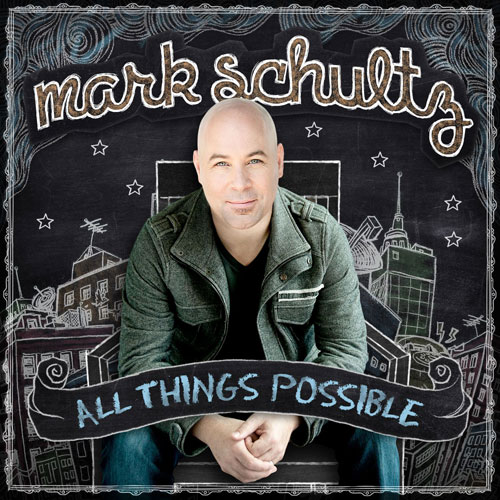
All Things Possible - Mark Schultz


God is the greatest reality and that makes all things possible.

All Things Possible
Artist: Mark Schultz (www.markschultzmusic.com)
Label: Fair Trade Services LLC
Length: 10 tracks/35 minutes

Mark Schultz has never sounded better. All Things Possible may be his finest hour as a singer/songwriter. Much credit goes to Seth Mosley and Pete Kipley, the producers. Mosley shares some of the songwriting credits along with others like Cindy Morgan and Mia Fieldes. Mosley’s creative energies are everywhere. He also plays various instruments.

Modernized production makes Schultz more vibrant. The pop/rock has an edge, and the ballads are not overly sentimental. Vocals are restrained. It’s just what Schultz needed with his first release on a new label.

It may seem clichéd, but hope abounds. This is something that Christian artists like Schultz can offer in the world of music. It’s not built on utopian dreams or wishful thinking but on the reality of Christ’s death and resurrection. These tracks encourage while acknowledging the harsh realities of life. “It is Well” (not the hymn) is one example:

When my strength is gone
Oh your cross stands strong
And your mercy never fails
It is well

“All Things Possible” becomes a jubilant chorus of praise towards the end:

My God is strong and mighty
My God is faithful
My hope is in the Lord
For He is able

The resignation in “I Gave Up” is not about defeat. It’s a bold way of being done with the old and what weighs down. The opening line sets a defiant tone: “I gave up all my striving.”

I like the picture in “Love Walked In.” Believers in Christ can follow Him by walking in when others walk out. Early Christians cared for those abandoned by society. Later Christians did not desert the sick and dying during the Great Plague of London. Christ strikes me as One who does not leave for the reasons that humans do. The sober yet winsome melody is a perfect complement to the theme of restoration.

Presumably, “I Will Love You Still” is an ode to Schultz’s wife. It also applies to how God’s sees his children.

If ever you should fall
If ever you should break
If ever you should turn from me and slowly walk away

I will love you still

Piano, French Horn and strings are all that’s needed for this lovely melody.

A couple of tracks have short, distinct, and even whimsical flourishes at the end. It’s evidence of the care that has gone into this recording.

The love of family, Schultz’s wife and newborn child (2012), is a sanctifying influence. He looks like a contented man on a cover with a cartoonish city in the background. The city of God is far more real than the city of man. God is the greatest reality and that makes all things possible. 

Saturday, February 2, 2013

Sing like Never Before: the Essential Collection - Matt Redman


A heart making melody

Sing like Never Before: the Essential Collection
Artist: Matt Redman (www.mattredman.com)
Label: Sparrow/sixstepsrecords
Length: 15 tracks/72:20 minutes

The number of Matt Redman songs that are now familiar in modern worship circles is amazing. Some may wonder if they know any. Sing like Never Before: the Essential Collection brings the best together with a few bonuses, and listeners will mostly likely recognize some of these contemporary standards that are sung in churches around the world. 

The opening “10,000 Reasons (Bless the Lord) – Radio Version” is as memorable as anything that Redman has done and makes its first appearance on CD. Check your spiritual pulse if this has no appeal. Included are new recordings of “Our God,” Better is One Day” and “Love So High.”

One need not look further than opening lines to find poetic imagery:

The sun comes up, it's a new day dawning
It's time to sing Your song again
Whatever may pass, and whatever lies before me
Let me be singing when the evening comes

In “You Never Let Go” Redman enshrines a truth that we might consider astonishing if we avoid mindlessly singing it:

Oh no, You never let go
Through the calm and through the storm
Oh no, You never let go
In every high and every low
Oh no, You never let go
Lord, You never let go of me

God never lets go in every low? Isn’t that when we feel most abandoned? This promise is something to remember when a high is a distant memory.

Aside from being able to hear the original artist singing classics in our age, you get to hear the lesser known that deserve recognition like the new “Love So High.” Along the same lines is the tender, stripped-down, keyboard driven, “The Father’s Song.” It’s the heart making melody. It may especially resonate with the broken, those desiring a quiet sense of God’s presence. The same subdued longing is found on the better-known, “The Heart of Worship.”

One of the more unusual cuts is the closing, “Twenty Seven Million,” which also makes its debut on CD. It serves to raise awareness and offer hope in relation to human trafficking. It is a collaboration with LZ7, a dance/rap group that give it a strong urban vibe.

Redman lives in Brighton, East Sussex in the United Kingdom. The driving Brit pop/rock of artists like Delirious is in evidence, which adds to the appeal for a younger audience.

Redman may not be as celebrated as an artist like Chris Tomlin, but he is in the same class. Redman is a co-writer with Tomlin and a couple of others on “White Flag,” which is included on Tomlin’s new Burning Lights release. The two have shared stages and continue to do so as those that lead a new generation in worship.

Monday, January 28, 2013

The Life and Witness of Peter - Larry R. Helyer


In view of Christ’s return, Peter espouses the witness of suffering.

The Life and Witness of Peter
Author: Larry R. Helyer
Publisher: IVP Academic (www.ivpress.com)
Pages: 329

In The Life and Witness of Peter Larry R. Helyer connects the biographical, historical and theological. Readers will see how Peter’s teaching is informed by his life experiences, especially pivotal events like his eyewitness account of Christ’s transfiguration. The latter is prominent in the eschatology of 2 Peter, “In short, the transfiguration was a theophany (cf. Ex 19), an epiphany and a preview of the parousia. Peter’s eyewitness testimony confirms what the prophets foretold: the Lord will come on the clouds and establish his undisputed rule over all peoples. Evil doers are put on notice: a day of reckoning is looming—false teachers beware!” (258).

The author goes on to make a possible connection between the wording of the divine utterance at the transfiguration and God’s summons to Abraham. “Beloved,” “son” and the idea of being well-loved or pleasing are prominent. “A typological link between the binding of Isaac and the transfiguration of Christ is relevant if we remember the placement of this event in Jesus’ ministry. Shortly after coming down from the mountain, Jesus reveals the fate awaiting the Son of man in Jerusalem during the festival of Passover (Mk 9:20-32; Mt 17:22-23; Lk 9:43-45) (259). Humiliation precedes exaltation.” The binding precedes Christ bringing many sons and daughters to glory as alluded to by the author.

“Furthermore, the conclusion of the story of the binding of Isaac promises that Abraham’s offspring would be ‘as numerous as the stars of heaven and as the sand that is on the seashore’ (Gen 22:17-18). So too, at the parousia, the elect are gathered ‘from the four winds, from one end of heaven to the other’ (Mt 24:31), and they ‘inherit the kingdom prepared for [them] from the foundation of the world’ (Mt 25:34). The Abraham cycle concludes with this declaration: ‘Abraham gave all he had to Isaac’ (Gen 25:5). Believers, being ‘participants of the divine nature’ (2 Peter 1:4), are also ‘heirs of the gracious gift of life’ (1 Pet 3:7), indeed, heirs of ‘an inheritance that is imperishable, undefiled, and unfading, kept in heaven’ (1 Pet 1:4). In Paul’s words, believers are ‘heirs of God, and joint heirs with Christ’ (Rom 8:17). A typological reading of Scripture results in a richly textured theology” (259). Indeed, it does, just as Helyer’s analysis of Peter and his doctrine is rewarding throughout.

Particularly helpful are the asides and commentary on controversial passages. In Peter’s confession of Christ and the subsequent response from his Lord, Helyer identifies the conundrum, “The first question is this: Is Peter himself the rock, or is the rock the confession he makes? In the past, ecclesiastical affiliation virtually dictated one’s response. Roman Catholics affirmed the former and Protestants the latter. This oversimplifies the situation, and today one finds a wider range of nuances. Still, these two options remain the primary contenders.” Can you see in these words a voice of reason? Whether one agrees or not with what follows, this is the kind of perspective I value.

After some analysis, Helyer writes, “Though possible, the interpretation that the rock is Peter’s confession seems forced. Rather, Jesus designates Peter as the one who will exercise authority within the movement” (44).

Before anyone picks up stones, please consider the wisdom in his concluding comments, “Such an interpretation is a far cry from the fully developed Roman Catholic teaching on the origin of the papacy. One is not logically or historically compelled to acknowledge the latter by affirming Peter (and the apostles) as the foundation of the church” (Eph 2:20) (44). Balanced thoughts like these make books like this worth reading. It thrills me to see someone showing where the truth points without accepting distorted ramifications.

Being broadminded does not require having views that are not biblical. Indicative of his generosity in spirit, in a footnote toward the end of the book, the author writes, “I take this opportunity to encourage my fellow evangelicals to read some of Benedict XVI’s books. Three that I have found helpful are Jesus of Nazareth (New York: Doubleday, 2007); Saint Paul (San Francisco: Ignatius, 2009); Credo for Today: What Christians Believe (San Francisco: Ignatius, 2009). May he, like Peter, faithfully ‘tend the flock of God that is in [his] charge’ and ‘win the crown of glory that never fades away’ (1 Pet 5:2, 4)” (283).

This is not a commentary, and yet, it serves as one indirectly, especially in relation to 1 & 2 Peter. One example is the exegesis of 1 Peter 3:18-22. Questions arise from the first two verses of the passage: “For Christ also suffered once for sins, the righteous for the unrighteous, that he might bring us to God, being put to death in the flesh but made alive in the spirit, in which he went and proclaimed to the spirits in prison” (ESV). Helyer identifies the key questions as:

·         Where did Christ go after having been made alive “in the Spirit (or spirit)”?
·         When did Christ go there?
·         Who are “the spirits in prison”?
·         What was the nature of the proclamation to them? (149)

He then summarizes three leading interpretations before sharing the one he favors accompanied by the merits and deficiencies of each view. In short, the first view sees Christ preaching through Noah to the pre-flood generation. The second advocates Christ preaching in the spiritual realm to the souls of deceased humans, consisting either of those who perished during the flood of Noah’s time, the souls that died before Christ’s incarnation or all souls, who are believed to have a postmortem opportunity to respond to the gospel. The author clearly favors the third view of Christ proclaiming “his victory over the rebellious spirits (fallen angels and/or their demonic offspring) who were imprisoned as a consequence of their sin (Gen 6). This preaching, which was not an invitation to be saved, announced their certain, final judgment and took place during his ascension” (149-150). The preaching occurred between Christ’s crucifixion and resurrection in the first two options. This is all serves as an example of the careful and informed scholarship that you consistently find.

It would be a mistake, however, to think of this only in terms of the academic. Pastoral applications and insights abound. One in particular, which stems from a verse most often applied to women, is broadened in a beautiful way. “Futhermore, a gentle and quiet spirit is not a gender-specific admonition; it is powerful paradigm for both genders, since it is the path trod by the Suffering Servant who invites each believer to follow in his steps (1 Pet 3:4, 7; cf. 1 Pet 2:23)” (304). This fits wonderfully with what Helyer sees as paramount in Peter’s theology, “The testimony of bearing up in a Christ-like manner when undergoing suffering for his name should never be underestimated” (181-182). 

Monday, January 21, 2013

Archivist 4th Edition: Vintage Vinyl Jesus Music 1965-1980 - Ken Scott


Who knew that the Jesus movement would produce such a wealth of music on vinyl?

Archivist 4th Edition: Vintage Vinyl Jesus Music 1965-1980
Author: Ken Scott
Print on demand at Lulu Marketplace
Pages: 370 

Who knew that the Jesus movement would produce such a wealth of music on vinyl? If you find it hard to believe, order the Archivist by Ken Scott, which looks at approximately 3,200 Jesus music albums. The volume of research alone is enough to excite me to explore this definitive guide.

It’s no exaggeration to say that this is essential for the collector of vinyl Jesus music. Maybe you are amazed that such a person exists. You find it hard to imagine why anyone would be interested in this music. This book is evidence that there is far more to this era than just the usual suspects like Larry Norman, Love Song, Andrea Crouch, etc. Sure, it has its share of the inferior and even cheesy, but that’s characteristic of any time. What Ken Scott does is help collectors and listeners separate the wheat from the chaff, even on individual recordings.

He is an excellent guide to a vast variety of music, including releases from the UK and other countries, some of them like treasure waiting to be discovered by those who appreciate quality music. It’s obvious that Scott recognizes it when he hears it. He gets more than a little enthusiastic about the 500 press self-titled 1978 UK release from Caedmon, “The professional standards set by this custom are so astonishing (that) all other Christian folk albums sound anemic by comparison. The production, the arrangements, the playing, the songwriting, the enamoring vocals of lead singer Angela Nayor – everything on this album is A+ throughout.”

Scott is not afraid to be forthright about the shortcomings of a release, but he does so with charity, and even humor. Witness his opening about With Your Love (1979) by Chris Christian, “For anyone who’s ever hummed along to an Air Supply or Christopher Cross tune, the easy pop-rock of Chris Christian just might provoke a similar response. It really annoys me when I catch myself sort of liking this kind of stuff (by the way, that fluttering sound you just heard was my credibility flying out the window.)”

He purposely excluded some releases to avoid being overly critical. Scott views all of the entries, which are descriptions of what you can expect rather than critical reviews, as worth checking out.

Since the movement that produced this output began to wane by the early 1980s, this serves as the cutoff point. If an artist, say DeGarmo & Key, for example, had output beyond this timeframe, it is not included. However, in this case and in many others, some of the most distinctive material came early before the music morphed into the more homogenized contemporary Christian music sound.

The greatest reason to own this may be the new discoveries. Popular and well-known artists are here but there are far more entries about artists and albums that will be unfamiliar to most Christians. Even if you are not a collector, they are fun and educational to read. It is also clear that they represent vintage music that is still worth hearing. Even today, they may still be relevant and remind us of a remarkable move of God.

This covers a segment of history with more depth and insight than any other resource. 

All Joy - Natalie Layne

  Hearing the joyful sound All Joy Natalie Layne Length: 13 songs, 42 minutes Label: Centricity Music I like the company that Natalie Layne...