Monday, March 31, 2014

Love Will Have the Final Word - Jason Gray


When the ruins are all we see … It only means love isn’t finished yet

Love Will Have the Final Word 
Artist: Jason Gray (www.jasongraymusic.com/)
Label: Centricity Music
Length: 11 songs/42 minutes

In the CCM 35th Anniversary Issue, TobyMac, formerly of dcTalk, said, “One of the things we lose perspective of is how needy we are.” One reason why I like Love Will Have the Final Word and each of Jason Gray’s releases is that he continually reminds me of my need for grace.

One obvious example is “Don’t Know How,” where someone could mistakenly interpret the opening lines as a before Christ experience. Rather, when Gray sings, “I want to believe but I don’t know how/Trust what I can’t see but I don’t know how,” he is recognizing his utter dependence on God, particularly when “baptized in the burning flame/when the troubles come my way.”

The distorted background, sounding like tranquilized grunge, complements the desperation in the lyrics and vocal delivery: “I have no choice but to cry out for you/Please help ’cause I’m helpless now.” I relate to this brokenness and the longing for wholeness, more than unattainable perfection.

If we read to know that we are not alone, the same can apply to listening. On the title track, when Gray sings, “When the voice of fear rages in my head/Reading down a long list of my regret/When the ruins are all I see/Remind me that it only means love isn’t finished speaking yet.” It helps me to know that I am not the only one to see the ruins. I need the reminder that “As long as God is on His throne/I am carried by the hope that love will have the final word.” Haunting, echoing guitar lines add an ethereal quality.

One could easily conclude that this life is characterized by sorrow, but joy will not be absent on the morning when we wake from the slumber of the world’s long night. In the eternal scheme, joy is deeper than sorrow.

One might not think that a song with the phrase “Ha Ha” would even fit, much less convey a real sense of joy. But the opening, exuberant “Laugh Out Loud” makes it work with handclaps, mandolin, and is that the sound of a hammer dulcimer? Let me underscore: it’s no small thing to find hints of heaven in a song. This puts a smile on my face. It’s like Gray is singing, “Spring up, o well (of bliss), within my soul.” If all this isn’t enough, it’s topped off by a chorus of hearty whistling.

This is followed by “With Every Act of Love,” a similar-sounding track with a larger than life chorus of “ohs” that leads me to anoint Gray as a king of the monosyllables. This is the soundtrack for when “heaven touches earth.” As Gray sings on the bridge, “God put a million, million doors in the world for His love to walk through/One of the doors is you.” This is a triumphant vision of God’s kingdom being brought to the world through every act of love. The recording is worth having just for these first two songs alone.

If a song can awaken compassion and encourage people to be tenderhearted, it is “If You Want to Love Someone.” Gray fleshes-out what it looks like when he sings, “Somehow you had a way of seeing just how deep my wound could go/Oh, but you were never scared to run and meet me there/That’s how I know/If you want to love someone/Search their soul for where it’s broken/Find the cracks and pour your heart in/That’s what You did.” It may be his way of saying that God met him at the point of his greatest sorrow and need. It’s an example of how through developing trust we can help the hurting.

“The Best Days of My Life” is Gray at his autobiographical best. It brims with hope as do most of these tracks. Need encouragement? You can find it here.

I appreciate the cover of a vigilant, bow-tie clad Gray, clouds and sky in the background, holding a broken pot together, which contains a beautiful bloom. It reminds me of the Heavenly Father, Who ever mindful of our fragile estate, loves us as we are and not as we should be (“As I Am”). He holds us when our world comes apart.

Sunday, March 30, 2014

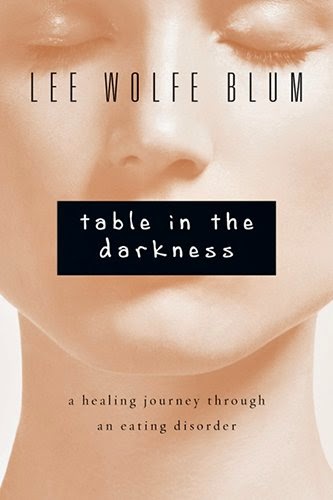
Table in the Darkness: A Healing Journey through an Eating Disorder - Lee Wolfe Blum


What recovery looks like

Table in the Darkness: A Healing Journey through an Eating Disorder
Author: Lee Wolfe Blum
Publisher: IVP Crescendo (www.ivpress.com/crescendo/)
Pages: 200

Ye fearful saints, fresh courage take;
The clouds ye so much dread
Are big with mercy and shall break
In blessings on your head (William Cowper).

Though inwardly compelled to make the review request, it was with a sense of dread that I approached Table in the Darkness by Lee Wolfe Blum. Even though many years ago I read with interest and benefit Starving for Attention by Cherry Boone O’Neill, I was slightly fearful of immersing myself once again in the throes of an eating disorder. But like the lines from the stanza by William Cowper, my fears proved groundless. Those clouds of dread were quickly dissipated as I became engrossed in a story big with mercy that brought blessing instead of condemnation.

It may be cliché, but nevertheless true, that this story is not as much about eating as it is about intangibles that shape us more than we realize. The disorder is a symptom of the lack of love and acceptance that we all crave but ultimately can only be found in an intimate relationship with God. Wolfe’s disorder was a flawed coping mechanism used to numb her pain.

It was an alter-ego that could bring a measure of comfort but increasingly became dominant “Ed was mean and brutal, no longer a friend; he was now a warden in my prison of his making. He was demanding and would say anything to keep me trapped. I no longer had a voice to fight back, with Ed’s voice so much louder” (104). This recounting of her self-talk, a major part of her struggle, is insightful.

While this is “raw, real and revealing,” as Cherry Boone O’Neill writes on the back cover, it’s a story told with dignity. It’s not gross or too graphic. It is, however, told with so much honesty and recollection of detail that this will be more than a little helpful for anyone with an interest in this area.

I did not want to read more than a chapter a day, so that I might prolong and savor the experience. I don’t want to narrate the particulars, better to let Blum tell it. I extend to potential readers something that I enjoy: the element of surprise.

This is not primarily self-help or a clinical evaluation; although the last chapter does provide details of what Blum’s recovery looked like. The points she enumerates are challenging but essential. Prior to this, it remains a narrative of the highs and lows of her life from childhood to the present. It includes a love story and the important roles played by family and friends.   

By illustrating from her life in a truthful manner rather than just telling what a person with an eating disorder should do, the author lets readers make their own connections and applications. When someone artfully presents reality, it can be like looking in a mirror. I, therefore, see how I am and how I might need to change.

This volume almost never came into being, and what a pity if that had been the case. It’s an extremely helpful and hope-filled book. I’m thankful for author’s vulnerability and the publisher’s willingness to put this amazing redemption story into print.

I note in passing that this is under a new imprint, IVP Crescendo. I heartily applaud the expressed intent: “IVP Crescendo is a new line that celebrates the significant and serendipitous results that arise wherever women apply their vision and gifts to the good of the whole church.” I will be interested to see and perhaps review what other titles spring from this line. Ladies, may I suggest that you keep your eye on their webpage.


I almost missed the grace found here because of those clouds of dread. I need to remember: there is no fear in love! Don’t shy away from this one. Any clouds of reluctance may be the precursor to God’s fullness raining down. 

Monday, March 10, 2014

On Heaven and Earth: Pope Francis on Faith, Family, and the Church in the Twenty-first Century


Scholarly dialogue on human flourishing and compassion for people are what makes this special.

On Heaven and Earth: Pope Francis on Faith, Family, and the Church in the Twenty-first Century
Authors: Jorge Mario Bergoglio & Abraham Skorka
Publisher: Image
Pages: 236

Something in me wants to champion the underdog. I see the least of these. Maybe it’s because I am one. I also recognize that some of the best gifts come in plain packages. There may be little hint of the treasures within.

It may be why I am pleased to draw attention to On Heaven and Earth. In the canon of books that come from Pope Francis, this may get overlooked and not be highly regarded.

It’s the illegitimate child, written before Francis became Pope. It was first published in Argentina in 2010, when Jorge Mario Bergoglio, the future pope was a cardinal. It was never planned as a book.

It grew from an interfaith dialogue with Rabbi Abraham Skorka. The mutual high regard and close bonds that formed prompted the rabbi to propose a book, to which Bergoglio immediately assented.

Would you rather see a sermon than hear one? The cardinal and rabbi provide a lesson in civil discourse that could replace many a sermon.

Even though they retain differences, in writing “On Religious Leaders,” they agree and embody a key virtue. Skorka writes in reference to Jeremiah 27, “The other concept that this story teaches us has to do with the most important term that should define a religious leader—the only virtue that the Torah explicitly applies to Moses—humility. Any religious leader that is prideful and lacks humility, who talks arrogantly and in absolutes, is not a good religious leader” (31). Further in the conversation, Bergoglio writes, “Taking up the theme of religious ministers, humility is what gives assurance that the Lord is there. When someone is self-sufficient, when he has all the answers to every question, it is proof that God is not with him” (33).

The two leaders tackle a host of subjects from predominantly ideological viewpoints. Theology enters in, but the book deals a lot with human flourishing. Scholarly reflections combined with compassion for people and communities are the highlights for me.

Subject matter that includes guilt, fundamentalism, women, politics and power, abortion, divorce, same-sex marriage, communism and capitalism, and the Arab-Israeli conflict are more than a little interesting. How many books feature a frank discussion by a rabbi and pope on the Holocaust?

Each topic covers a few pages where the participants respond to each other. The brevity constrains the depth but makes it a quick reference guide. Argentine politics and history occasionally enter in but don’t significantly detract.


For those who desire understanding, this book is helpful. Communicating with those who have different views can refine our own, helping us to see what we may have overlooked, or where we could be wrong. It can also foster intimate bonds as it did here between a future pope and a rabbi. Even when disagreements remain, how much better it is to see a person as someone to be respected and loved rather than an adversary.

Wednesday, February 19, 2014

Stand in Awe - Jon Thurlow


Things are not okay, and they won’t be until Christ returns.

Stand in Awe
Artist: Jon Thurlow
Label: International House of Prayer (www.ihopkc.org)
Length: 11 tracks/1 hour 1 minute

Stand in Awe by Jon Thurlow strings biblical allusions together, conveying longing and hope for the transcendent. This is a less is better approach. Better to have five words that are inspired than a hundred that are not.

A slight drawback is it that it tends toward repetition. On the upside, this can aid a person in concentrating on the object of worship more than singing words. That’s the downside of more complicated songs. It can become an intellectual exercise.

Those who want a meaningful balance have no need for concern. There is plenty to meditate on, and the repeated phrasing can facilitate it. It gives one the chance to catch what is being sung.

One of the brightest moments is “Have the Glory,” which starts with bouncy drums and synth, reminiscent of The Killers. This highlights the parable of the soils, where Jesus talks about the good soil producing thirty, sixty and even a hundred fold from what is sown. A. W. Tozer, who could focus on truth like a laser, once remarked about the absence of joy in worship. Even though we have innumerable praise choruses and try to manufacture gladness, his sentiment, spoken many years ago, would seem to hold true in our own time. The note of joy endears me to this track. How we need authentic manifestations in our gatherings today.

On the more somber side, but not inappropriately, is the title track. It begins with violin taking the lead, much like Michael W. Smith’s “Agnus Dei,” which is similar in style. There is a slow build to a crescendo before it begins to ebb like a retreating tide.

In between these two songs, Thurlow throws a bit of a changeup, using light jazz, R&B, gospel and strings to provide more lightheartedness and welcome variation.

Lyrically, many of the songs here and on other International House of Prayer (IHOP) releases, reflect a theology of having a strong love for Christ. The danger to which they may be most susceptible is to distort and take the bride and bridegroom analogy to an extreme.

The January 30, 2014 issue of Rolling Stone featured the article, “Love and Death in the House of Prayer,” which profiled an offshoot of IHOP and shows how dangerous wrong thinking and practices can be. It should serve as a cautionary tale to everyone, especially those connected with this ministry. After reading the article, I can more readily see the influence of IHOP doctrine in the music releases, not that it is all bad.

I digress further, but I can’t help thinking that it would be beneficial if IHOP leaders allowed their theology and practices to be scrutinized. It may need to come from outside the organization. Pride makes us believe that we know best and are not answerable to anyone. What life might come from being humble and teachable, willing to admit when we are wrong.


On a lighter note, piano is Thurlow’s instrument of choice, so there are plenty of keyboards. They help close this release with “Things are Not Okay.” I liked this title, even before I heard the song. It does not disappoint. It’s a fitting conclusion that reminds listeners that this world won’t be right until Christ returns. What’s wrong includes our faulty attempts to live the Christian life.

Saturday, February 1, 2014

The Hymn Sessions, Vol. 1 - Jimmy Needham


Words fail to describe the joy

The Hymn Sessions, Vol. 1
Artist: Jimmy Needham
Label: Platinum Pop
Length: 10 tracks/40:44 minutes

The Hymn Sessions, Vol. 1 by Jimmy Needham reminds me that language often falls short in conveying reality. Think of Scripture’s depiction of heaven. It is a glimpse through a glass darkly. What we see and know is little more than the tip of the iceberg.

How do I describe Needham’s interpretation of “Rock of Ages”? Is it funk? Is it R&B, or some combination of both? Words fail me. It starts with vocal gymnastics that are a prelude to snappy percussion. Bass lines dance around big beats. Whatever it is, my heart is smiling.

As much as I like hymns, some are so familiar as to make them tiresome. Not so here. These adaptations, which vary from straightforward to exotic, have me alternating between jumping for joy and feeling peace like a river.

“Great is Thy Faithfulness” is just soulful singing and expert picking on an acoustic guitar for a pristine loveliness. “Holy, Holy, Holy” begins with raw emotion and the sounds of a church organ. It takes on a beautiful delicacy as piano, acoustic guitars and background vocals, courtesy of Shane & Shane, provide restrained accompaniment.

At the other extreme you have songs like “How Great Thou Art.” Rapper Trip Lee riffs on the greatness of God before Needham jumps in with the traditional chorus to the sound of rock chords. It’s a long way from a song for altar calls, but it becomes more relevant to a new generation.

“Come Thou Fount” is jazz complete with horns. This may be too much for purists, but I find it refreshing. It’s hearing the familiar in novel ways.

“Joyful, Joyful” may be Needham at his best. It has a new melody, an added chorus and some brief instrumental interludes, all in an R&B groove. This influence is felt throughout.

The classics are framed by two original songs. After an opening prelude of industrial-sounding Latin chant, “The Gospel” explodes with modern rock. Fittingly, “It Is Finished,” a song about the completeness of Christ’s work brings the recording to a close. It’s a gorgeous conclusion of lofty and delightful sentiments. Words escape me. Descriptions fall short.   


Amazing! On one hand, my mother would appreciate the moments of stark allure. On the other, the wild creativity might lead one to inwardly laugh out loud. As Needham sings, “You make me joyful.” What better way is there to describe it?  

Thursday, January 16, 2014

Country Faith: 56 Reflections from Today’s Leading Country Music Stars


A coffee table book for the country music fan

Country Faith: 56 Reflections from Today’s Leading Country Music Stars
Compiler: Deborah Evans Price
Publisher: Zondervan
Pages: 128

Early in the twentieth century, F. W. Boreham, an extraordinary communicator, commenced a unique sermon series on alternating Sunday nights titled “Texts That Made History.” These carefully crafted messages extended over the course of 125 Sundays, eventually filling five books. In each one, Boreham expertly traced the impact of Bible verses on historical figures, including famous fictional characters. He identified a verse in each life that animated and enriched their existence.

Now flash forward to today. Country Faith in a remote way could be likened to a relative of that historical series. This book documents the profound influence of Bible verses in the lives of country music stars. From the lesser known to well known artists, including Carrie Underwood, Josh Turner (who also writes the foreword), Wynonna, Charlie Daniels, Billy Ray Cyrus, and Sara Evans, each person provides an abbreviated testimony of the ongoing impact of a particular passage.

Anywhere from one to four paragraphs are framed by a beautiful portrait of the artist and exquisite graphic design. It only takes a minute or two for each reading. Together they function like an evangelistic tract. Give this to a country music fan that may have only a casual interest in the gospel. Leave it out in your home for someone sitting down to relax. The attractive cover invites inquiry.

Sharing the gospel is more than afterthought. The book ends with the complete text of the Gospel of Mark, including a brief introduction.

Due in part to this being a gift book, the writing lacks the depth of a devotional. Those wanting something more than the superficial will need to look elsewhere. Even so, this works well as an evangelistic and/or inspirational tool for those without faith or those looking for some quick refreshment.  

Perhaps this could become a series of its own, with the next volume surveying the testimony of the Bible’s impact on rock stars. With greater detail, such might be a welcome addition.


Michael Dalton

Tuesday, January 14, 2014

So We Would Know - Treva Blomquist


Treva Blomquist adapts ancient verse to make them sound like folk anthems.

So We Would Know
Artist: Treva Blomquist (www.trevamusic.com)
Label: Independent
Length: 11 tracks/36 minutes

The words in hymns often register a responsive chord. They communicate in language that is not as common. Though this makes them less intelligible to some, for me it’s like finding the pearl of great price. It is worth any sacrifice in initial comprehension to discover the treasure hidden in the field. Their sublime truths are like majestic mountains, often elevating the character of God and the work of Christ.

On So We Would Know Treva Blomquist adapts ancient verse to make them sound like folk anthems. Grace and grit make them more than a little accessible. There are a minimum of players, production and percussion, which is fine by me. It’s little more than Blomquist’s crystalline voice and mostly stringed instruments, giving this a decidedly Americana feel.

Just when I feel like she more than finds her niche on the rousing “Ain’t No Grave” and “Run to Meet My Lord,” both strongly bluegrass, she follows with a beautifully subdued ballad, singing ever so gently. This is the grace following the grit.

“Pass Me Not” is a stunning revelation along the lines of the former. It’s like hearing it for the first time. It’s not just a new arrangement, which she makes use of at times. The serene setting highlights eloquent singing.

These songs are rich in theology that comforts. They provide glimpses of God’s attributes. They give voice to those now dead, who speak again across the divide of years of “Thou Who was Rich” but for our sake became poor that we might experience His riches. The affirmation of who God is reassures that “My Anchor Holds”; it is not tenuous. Christ is “All that I Need.” Oh, “Take Me Savior” to the place “Where Freedom Speaks.”

The Ache - Brandon Heath

  An honest look at life and one of the best recordings of the past year. The Ache Brandon Heath Length: 11 songs/36 minutes Label: Centri...