Tuesday, June 3, 2014

The Joy of the Gospel: Evangelii Gaudium (Apostolic Exhortation) - Francis


Surprised by Francis

The Joy of the Gospel: Evangelii Gaudium (Apostolic Exhortation)
Author: Francis (As listed on title page)
Publisher: United States Conference of Catholic Bishops
Pages: 152

I share the interest of many in Francis, the simple designation the Pope uses in the Joy of the Gospel, which has an appropriate subtitle, Apostolic Exhortation. Fitting because, being addressed to Catholics from lay people to leaders, it’s a challenging call to live the life of Christ in every dimension for the sake of evangelization.

This is far from a how-to-win-souls book. Rather, it’s remarkable for its comprehension of the all-encompassing nature of evangelism, elevating it above drudgery to joy, which is as it should be. Those seeking a fresh vision can find it here under the following broad headings:

1.       The Church’s Missionary Transformation
2.       Amid the Crisis of Communal Commitment
3.       The Proclamation of the Gospel
4.       The Social Dimension of Evangelization
5.       Spirit-Filled Evangelizers

Francis may not be thought of as an academic like his predecessor—on the basis of what I had read and heard I was expecting folksy inspiration along the lines of his namesake. What a surprise to find such a scholarly outlook filled with practical directives that even I as an evangelical can apply to my own life.

The simple writing style is an encouragement to me personally. I’m not verbose and neither is Francis. He gets to the point with hardly a wasted word.

Each chapter is organized under sub-heads that have numbered sections containing an average of one to four short paragraphs. The sections are consecutively numbered from the beginning of the book.

There is treasure in readily accessible form in each of these 288 divisions. I could revisit them repeatedly and be enriched each time.

The author only lost me with an occasional reference to the Eucharist and in the concluding part that deals with Mary. The latter was a slight let down.

I realize that some might not even consider this volume because of their differences with the Catholic Church. If, however, one approaches it with an open mind to glean what is helpful rather than reading to find fault, one can be the wiser for it. I don’t want to be too proud to learn from anyone. That’s not to say there is no need for discernment.

It’s the capacity that one needs when reading N. T. Wright, John MacArthur, and one of my favorites, F. W. Boreham, or any other author. We grow in our ability to separate the wheat from the chaff in part by being exposed to views that differ from our own. Sometimes we need the help of contemporaries and/or ancients to help us find our way. This is part of the value of reading books.

Whatever we think we know, in a sense we know it imperfectly. I am wrong without realizing it. I fail in many ways and see imperfectly. It’s why we need to evaluate and avail ourselves of resources that God provides.    

There is one book that towers over and has inspired this and countless others in Christendom. If we have time for nothing else, the Bible must be our lodestar. Everything else must stand in the light of it.

In the Winter/Spring 2014 issue of Image, Kathleen Norris writes, “However the cultural winds are blowing, I believe that the task for artists of faith is the same as it has always been. Whether or not the culture accepts their work, their job is to reject the false and seek the true; to shun sentiment and formulaic happy endings in favor of passion and surprise” (83). Francis may not be considered an artist, but in this work he rejects the false and seeks the true. He shuns sentiment and formulaic answers. He writes with passion and surprise, which makes this a joy to read.


Friday, May 30, 2014

Sovereign - Michael W. Smith


A new label, a new dynamic

Sovereign
Artist: Michael W. Smith (www.michaelwsmith.com)
Label: Sparrow Records
Length: 12 tracks/54:33 minutes

Michael W. Smith is a musical virtuoso, but he may never be more dynamic than when he leads worship. Look no further than Sovereign, which is his latest and finest effort in this category. I might take this over any of his previous releases.

These songs are straightforward with restrained artistry, giving them broad appeal.

They exude the power that comes from combining rock and worship. The choruses are like the roar of many waters! The God of glory thunders and so does the music in the crescendos. In contrast, it is often like a gentle whisper at beginning and end when it’s little more than just Smith and a piano. I like hearing his earnestness and tenderness to sparse accompaniment.

Credit is due in part to partnership with a new label, Capitol Christian Music Group. Smith wisely chose to be open to input and direction, knowing that iron sharpens iron.   

Though it is a studio recording, it has the vitality of the live recordings that our popular in this genre. It’s easy to imagine it being performed in arenas filled with throngs of people singing along. It rivals its secular counterparts because of its object. The sense of majesty is but the dim reflection of God’s awesome glory, which is beyond description.

One of five cover songs is “Christ Be All Around Me.” It’s an excellent adaptation with a chorus derived from early Irish poetry:

Christ with me, Christ before me, Christ behind me,
Christ in me, Christ beneath me, Christ above me,
Christ on my right, Christ on my left,
Christ when I lie down, Christ when I sit down, Christ when I arise,
Christ in the heart of every man who thinks of me,
Christ in the mouth of every one who speaks of me,
Christ in every eye that sees me,
Christ in every ear that hears me.

It serves as a lovely reminder of the pervasiveness of God’s presence.

Two of my favorites, “Hide Myself” and “You Won’t Let Go,” are collaborations with a couple of the best songwriters in Christian music, Mia Fields and Seth Mosley. These songs are such a winsome blend of pop, praise and comfort. Does it anyone do it better than Smith?

I like the closing duet with Kari Jobe (“The One That Really Matters”), but it is a little long and repetitive. It detracts somewhat from the powerful thought that in the end, pleasing God is all that matters.


Sovereign debuted at No. 10 on the Billboard 200. Just prior to this, Smith and Cracker Barrel Old Country Store released Hymns, Smith’s take on classic hymnody. 

Friday, May 2, 2014

The Beatles, the Bible, and Bodega Bay - Ken Mansfield


The only book approved by The Beatles

The Beatles, the Bible, and Bodega Bay (http://www.fabwhitebook.com/html/meet_ken.html)
Author: Ken Mansfield
Publisher: Broadman & Holman Publishers
Pages: 299

“Gracious words are like a honeycomb, sweetness to the soul and health to the body” (Proverbs 16:24 ESV). In The Beatles, the Bible, and Bodega Bay (2000), Ken Mansfield, in writing about another Beatle insider book, said, “My greatest objection was the dark-side approach he (Peter Brown) took to events and the Beatles themselves. I think there must have been two John Lennons—I never met his!” (92). This is indicative of Mansfield’s viewpoint and what makes his book a delight.

His approach becomes even clearer when he describes the forces that eroded the band’s “childlike quality,” which he saw as “a common thread that ran through the very fiber and being of the Fab Four.” Mansfield writes, “My eternal naiveté and potato-bred simplicity saved me. I looked for and only found their goodness and gentle natures. I found them idealistic and still able to dream, vaguely unaware that they were being pulled into an externally induced nightmare” (243-244).

Their musical prowess made Mansfield into an awe-inspired friend. He admits that “he may have even forgotten what I don’t want to remember.” He knew that they liked him and was protective as a result. “I do know that they trusted me, and in order to dig up dirt or caustic observations about these times and these people, I would either have to become a fiction writer or betray that trust,” (245) he explains.

Even in relation to John Lennon, he offers a counter view to his much publicized caustic side. “It is unfortunate, but I fear most people never got to see the casual, lightness-of-being aspect of John Lennon. I am personally offended by the disproportionate amount of negative verbiage written about other areas of his brilliant life” (220).

It’s no wonder that this is the only book ever approved by The Beatles (Yoko One on John Lennon’s behalf). It’s honest and revealing without being critical.

Readers get warm glimpses not found elsewhere: “Life with George in these situations was always comfortable and natural, almost everyday like; he made it that way. He was easy to be with—gentle, kind, and caring. Although I was supposed to be taking care of him, he would always concern himself with how I was doing. He had a bashful, soft-spoken manner with friend and stranger alike, and always appeared to care about others” (137).

Ken Mansfield is the former U.S. manager of Apple Records. That’s him huddling from the cold against the chimney between Yoko and Maureen Starkey when the Beatles gave their final performance on that rooftop. 

Despite the weather and a host of adverse circumstances, it was a triumph that led Mansfield to conclude, “After thirty years in the heart of the record business—offstage, onstage, and backstage with everyone from Roy Orbison to Don Ho—I personally feel that the Beatles were the greatest rock and roll band of all time” (110). Mansfield sees it as the “one event that stood out above all the others during the time” (105) that he worked with the Beatles.

It would be disingenuous to let someone think that the book is merely recollections about The Beatles. Sandwiched in between these wondrous accounts are dispatches, some 20-30 years later, from Bodega Bay, known as the setting for Alfred’s Hitchcock’s The Birds. Far from the dread and fear in that movie are the serene Christian reflections inspired by the natural beauty of the fishing village’s coastline.

These are not lightweight devotionals. It’s a mature Christian seeing God’s hand in all the created wonder that surrounds him. They are much like the Psalms, expressing a full range of human emotions.

At first the transition from one time period to another can be a little jarring, and depending on preference, one can easily want to get through the sections they like least, but that would miss the beauty found each and not see this as a whole. It is a journey from the pinnacles of the music world to the riches of a life lived simply in Christ.

The book features many rare photos and images from Mansfield’s time with the group, along with timelines in the chapters showing significant dates of recordings and other events.

Mansfield also wrote The White Book, The Beatles, the Bands, the Biz: An Insider’s Look at an Era (2007), Between Wyomings: My God and an iPod on the Open Road (2009) and Stumbling on Open Ground: Love, God, Cancer, and Rock 'n' Roll (2013).


Mansfield humanizes The Beatles in a winsome way. This is far removed from the books that disillusion and dissipate hope. These gracious words are sweet to the soul and health to mind and body.

Wednesday, April 23, 2014

A Permeable Life - Carrie Newcomer


Miracles and magic in everyday life

A Permeable Life
Artist: Carrie Newcomer (www.carrienewcomer.com)
Label: Available Light Records
Length: 12 tracks/48 minutes

It’s my loss that Carrie Newcomer’s twelfth studio recording is only my second meeting, the first being The Geography of Light (2008). I have been enriched by each visit, which leads me to believe that becoming acquainted with her other works will bring further delight. If Newcomer is a stranger but you enjoy someone like David Wilcox, take the time to listen to the beauty and depth that this artist offers.

You might find yourself captivated by “Writing You a Letter” on A Permeable Life. The song conveys a sense of awe and mystery, especially in the music. Acoustic guitar, bass, keyboard, light percussion and violin combine in a way that hints at what is below the surface. Newcomer sings, “I’m a stranger here, I’m only passing through/But every place I go leaves its own tattoo,” while the chugging pace provides a sense of journey. This train is bound for glory but don’t expect to remain unchanged along the way.

The sublime sounds make the world seem rife with possibilities. It is my favorite track for the feeling that it conveys. It’s not often that a song can help me experience what cannot be completely named. It’s “miracles and magic.”

Actually, you find similar moments throughout this release. I know that along with stellar musicianship it is Newcomer’s Quaker background that brings such richness. The lovely prose and melodies are enhanced by the finger-picking that drives these songs.

Newcomer lightens the mood on “Room at the Table,” which invites all to partake of a bounty enough for everyone. “Forever Ray” celebrates a lifelong love that endures through the sunset years. The closing “Please Don’t Put Me on Hold” is Newcomer’s humor in full bloom. Anyone who has endured automated answering systems should be able to relate. 

As I write these next words, it is now the early hours of Easter. Christ rose not as a mere phantom but as flesh and blood. This has ever been the hope of the follower of Jesus: the resurrection of the body!

Christianity is incarnate from Advent to the empty tomb. It is concrete spirituality in the form of relationship. I find these two aspects beautifully embodied on “Abide,” the perfect end of day song.

The chorus invites shared presence: “Oh abide with me/Where it’s breathless and its empty/Yes abide with me/And we’ll pass the evening gently/Stay awake with me/And we’ll listen more intently/To something wordless and remaining/Sure and ever changing/In the quietness of now.” What is sure and ever changing? “There is living water/A spirit cutting through/Always changing, always making/All things new.”

Newcomer never needs to preach. Throughout this release she sets her faith in the context of human interactions. It’s delicately worked into every line of struggles and joys. This is not rugged individualism but a lifestyle built on the revelation disclosed in “Visitation” that there “is a hope that won’t let go.” It dawned on Resurrection Sunday and shines to the full light of day.

Lately, I have moments where I long for a renewed sense of wonder. Such a desire is continually obscured by the pace of life and the world’s many distractions. Newcomer’s work is like an ally helping me to find meaning not only in the burning bush but in every grain of sand. Let me be awe-inspired even in the commonplace. As Newcomer puts it, “To live permeably is to be open-hearted and audacious, to risk showing up as our truest self, and embracing a willingness to be astonished.”

Monday, March 31, 2014

Love Will Have the Final Word - Jason Gray


When the ruins are all we see … It only means love isn’t finished yet

Love Will Have the Final Word 
Artist: Jason Gray (www.jasongraymusic.com/)
Label: Centricity Music
Length: 11 songs/42 minutes

In the CCM 35th Anniversary Issue, TobyMac, formerly of dcTalk, said, “One of the things we lose perspective of is how needy we are.” One reason why I like Love Will Have the Final Word and each of Jason Gray’s releases is that he continually reminds me of my need for grace.

One obvious example is “Don’t Know How,” where someone could mistakenly interpret the opening lines as a before Christ experience. Rather, when Gray sings, “I want to believe but I don’t know how/Trust what I can’t see but I don’t know how,” he is recognizing his utter dependence on God, particularly when “baptized in the burning flame/when the troubles come my way.”

The distorted background, sounding like tranquilized grunge, complements the desperation in the lyrics and vocal delivery: “I have no choice but to cry out for you/Please help ’cause I’m helpless now.” I relate to this brokenness and the longing for wholeness, more than unattainable perfection.

If we read to know that we are not alone, the same can apply to listening. On the title track, when Gray sings, “When the voice of fear rages in my head/Reading down a long list of my regret/When the ruins are all I see/Remind me that it only means love isn’t finished speaking yet.” It helps me to know that I am not the only one to see the ruins. I need the reminder that “As long as God is on His throne/I am carried by the hope that love will have the final word.” Haunting, echoing guitar lines add an ethereal quality.

One could easily conclude that this life is characterized by sorrow, but joy will not be absent on the morning when we wake from the slumber of the world’s long night. In the eternal scheme, joy is deeper than sorrow.

One might not think that a song with the phrase “Ha Ha” would even fit, much less convey a real sense of joy. But the opening, exuberant “Laugh Out Loud” makes it work with handclaps, mandolin, and is that the sound of a hammer dulcimer? Let me underscore: it’s no small thing to find hints of heaven in a song. This puts a smile on my face. It’s like Gray is singing, “Spring up, o well (of bliss), within my soul.” If all this isn’t enough, it’s topped off by a chorus of hearty whistling.

This is followed by “With Every Act of Love,” a similar-sounding track with a larger than life chorus of “ohs” that leads me to anoint Gray as a king of the monosyllables. This is the soundtrack for when “heaven touches earth.” As Gray sings on the bridge, “God put a million, million doors in the world for His love to walk through/One of the doors is you.” This is a triumphant vision of God’s kingdom being brought to the world through every act of love. The recording is worth having just for these first two songs alone.

If a song can awaken compassion and encourage people to be tenderhearted, it is “If You Want to Love Someone.” Gray fleshes-out what it looks like when he sings, “Somehow you had a way of seeing just how deep my wound could go/Oh, but you were never scared to run and meet me there/That’s how I know/If you want to love someone/Search their soul for where it’s broken/Find the cracks and pour your heart in/That’s what You did.” It may be his way of saying that God met him at the point of his greatest sorrow and need. It’s an example of how through developing trust we can help the hurting.

“The Best Days of My Life” is Gray at his autobiographical best. It brims with hope as do most of these tracks. Need encouragement? You can find it here.

I appreciate the cover of a vigilant, bow-tie clad Gray, clouds and sky in the background, holding a broken pot together, which contains a beautiful bloom. It reminds me of the Heavenly Father, Who ever mindful of our fragile estate, loves us as we are and not as we should be (“As I Am”). He holds us when our world comes apart.

Sunday, March 30, 2014

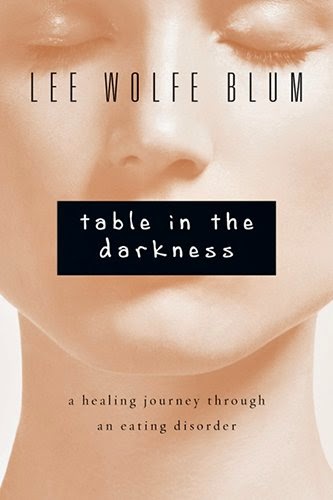
Table in the Darkness: A Healing Journey through an Eating Disorder - Lee Wolfe Blum


What recovery looks like

Table in the Darkness: A Healing Journey through an Eating Disorder
Author: Lee Wolfe Blum
Publisher: IVP Crescendo (www.ivpress.com/crescendo/)
Pages: 200

Ye fearful saints, fresh courage take;
The clouds ye so much dread
Are big with mercy and shall break
In blessings on your head (William Cowper).

Though inwardly compelled to make the review request, it was with a sense of dread that I approached Table in the Darkness by Lee Wolfe Blum. Even though many years ago I read with interest and benefit Starving for Attention by Cherry Boone O’Neill, I was slightly fearful of immersing myself once again in the throes of an eating disorder. But like the lines from the stanza by William Cowper, my fears proved groundless. Those clouds of dread were quickly dissipated as I became engrossed in a story big with mercy that brought blessing instead of condemnation.

It may be cliché, but nevertheless true, that this story is not as much about eating as it is about intangibles that shape us more than we realize. The disorder is a symptom of the lack of love and acceptance that we all crave but ultimately can only be found in an intimate relationship with God. Wolfe’s disorder was a flawed coping mechanism used to numb her pain.

It was an alter-ego that could bring a measure of comfort but increasingly became dominant “Ed was mean and brutal, no longer a friend; he was now a warden in my prison of his making. He was demanding and would say anything to keep me trapped. I no longer had a voice to fight back, with Ed’s voice so much louder” (104). This recounting of her self-talk, a major part of her struggle, is insightful.

While this is “raw, real and revealing,” as Cherry Boone O’Neill writes on the back cover, it’s a story told with dignity. It’s not gross or too graphic. It is, however, told with so much honesty and recollection of detail that this will be more than a little helpful for anyone with an interest in this area.

I did not want to read more than a chapter a day, so that I might prolong and savor the experience. I don’t want to narrate the particulars, better to let Blum tell it. I extend to potential readers something that I enjoy: the element of surprise.

This is not primarily self-help or a clinical evaluation; although the last chapter does provide details of what Blum’s recovery looked like. The points she enumerates are challenging but essential. Prior to this, it remains a narrative of the highs and lows of her life from childhood to the present. It includes a love story and the important roles played by family and friends.   

By illustrating from her life in a truthful manner rather than just telling what a person with an eating disorder should do, the author lets readers make their own connections and applications. When someone artfully presents reality, it can be like looking in a mirror. I, therefore, see how I am and how I might need to change.

This volume almost never came into being, and what a pity if that had been the case. It’s an extremely helpful and hope-filled book. I’m thankful for author’s vulnerability and the publisher’s willingness to put this amazing redemption story into print.

I note in passing that this is under a new imprint, IVP Crescendo. I heartily applaud the expressed intent: “IVP Crescendo is a new line that celebrates the significant and serendipitous results that arise wherever women apply their vision and gifts to the good of the whole church.” I will be interested to see and perhaps review what other titles spring from this line. Ladies, may I suggest that you keep your eye on their webpage.


I almost missed the grace found here because of those clouds of dread. I need to remember: there is no fear in love! Don’t shy away from this one. Any clouds of reluctance may be the precursor to God’s fullness raining down. 

Monday, March 10, 2014

On Heaven and Earth: Pope Francis on Faith, Family, and the Church in the Twenty-first Century


Scholarly dialogue on human flourishing and compassion for people are what makes this special.

On Heaven and Earth: Pope Francis on Faith, Family, and the Church in the Twenty-first Century
Authors: Jorge Mario Bergoglio & Abraham Skorka
Publisher: Image
Pages: 236

Something in me wants to champion the underdog. I see the least of these. Maybe it’s because I am one. I also recognize that some of the best gifts come in plain packages. There may be little hint of the treasures within.

It may be why I am pleased to draw attention to On Heaven and Earth. In the canon of books that come from Pope Francis, this may get overlooked and not be highly regarded.

It’s the illegitimate child, written before Francis became Pope. It was first published in Argentina in 2010, when Jorge Mario Bergoglio, the future pope was a cardinal. It was never planned as a book.

It grew from an interfaith dialogue with Rabbi Abraham Skorka. The mutual high regard and close bonds that formed prompted the rabbi to propose a book, to which Bergoglio immediately assented.

Would you rather see a sermon than hear one? The cardinal and rabbi provide a lesson in civil discourse that could replace many a sermon.

Even though they retain differences, in writing “On Religious Leaders,” they agree and embody a key virtue. Skorka writes in reference to Jeremiah 27, “The other concept that this story teaches us has to do with the most important term that should define a religious leader—the only virtue that the Torah explicitly applies to Moses—humility. Any religious leader that is prideful and lacks humility, who talks arrogantly and in absolutes, is not a good religious leader” (31). Further in the conversation, Bergoglio writes, “Taking up the theme of religious ministers, humility is what gives assurance that the Lord is there. When someone is self-sufficient, when he has all the answers to every question, it is proof that God is not with him” (33).

The two leaders tackle a host of subjects from predominantly ideological viewpoints. Theology enters in, but the book deals a lot with human flourishing. Scholarly reflections combined with compassion for people and communities are the highlights for me.

Subject matter that includes guilt, fundamentalism, women, politics and power, abortion, divorce, same-sex marriage, communism and capitalism, and the Arab-Israeli conflict are more than a little interesting. How many books feature a frank discussion by a rabbi and pope on the Holocaust?

Each topic covers a few pages where the participants respond to each other. The brevity constrains the depth but makes it a quick reference guide. Argentine politics and history occasionally enter in but don’t significantly detract.


For those who desire understanding, this book is helpful. Communicating with those who have different views can refine our own, helping us to see what we may have overlooked, or where we could be wrong. It can also foster intimate bonds as it did here between a future pope and a rabbi. Even when disagreements remain, how much better it is to see a person as someone to be respected and loved rather than an adversary.

The Ache - Brandon Heath

  An honest look at life and one of the best recordings of the past year. The Ache Brandon Heath Length: 11 songs/36 minutes Label: Centri...